Q.1 Define Waves and Explain How Waves Are Formed by Rope, Slinky, and Ripple Tank
Video Lecture
Understanding Waves and Wave Motion
Definition of a Wave: A method or process to transport energy from one point to another without the actual physical transfer of matter is called a wave or wave motion.
Every wave is governed by the fundamental wave equation linking speed (\(v\)), frequency (\(f\)), and wavelength (\(\lambda\)):
General Mechanism of Wave Formation
When the particles of a physical medium are disturbed, this disturbance propagates progressively from particle to particle. Through this mechanical interaction, energy travels across space, even though individual particles merely oscillate locally around their equilibrium positions.
Common practical demonstrations of mechanical wave propagation include:
- Waves on a Rope or String (Transverse Wave)
- Waves in a Slinky Spring (Longitudinal/Transverse Wave)
- Water Waves in a Ripple Tank (Surface Wave)
Demonstrating Wave Motion in 3 Physical Systems
1. Wave Motion Using a Rope
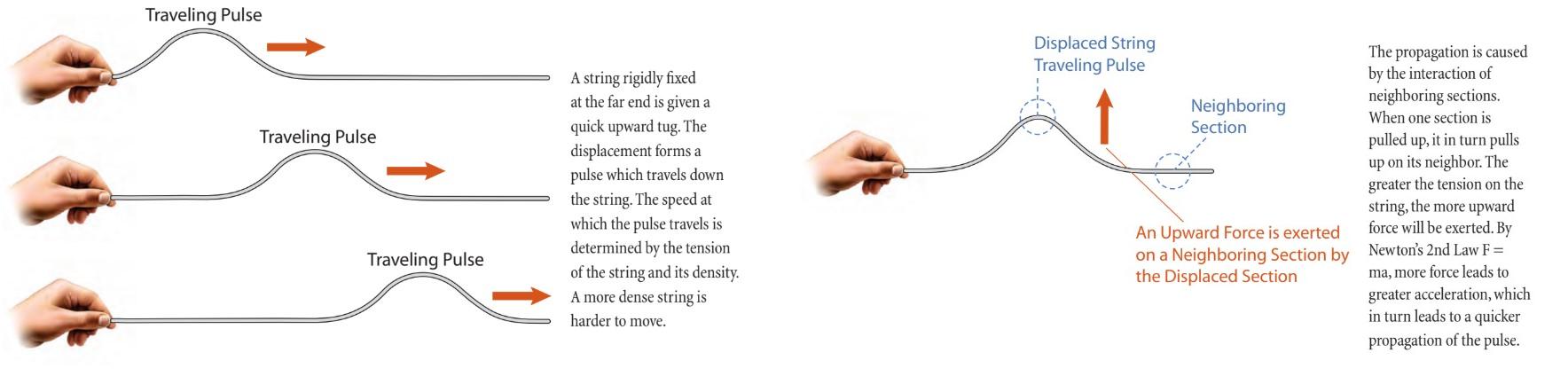
Waves can be produced on a flexible rope by securing one end to a fixed support (such as a wall or tree) and continuously shaking the free end up and down [00:04:29].
This up-and-down displacement creates continuous periodic oscillations [00:05:06]. The crests and troughs travel horizontally toward the wall while individual rope segments only move vertically [00:05:37]. Thus, the rope acts as the medium through which energy moves [00:06:42].
2. Waves in a Slinky Spring
A slinky spring is a pre-compressed helical or coiled spring ideal for demonstrating wave mechanics in lab environments [00:07:12]. Attach one end of the spring to a rigid wall and stretch it along a smooth tabletop.
Moving the free end horizontally back and forth creates alternating regions of high density (compressions) and low density (rarefactions) [00:08:15]. These humps travel across the spring while individual spring coils simply vibrate back and forth locally.
3. Water Waves in a Ripple Tank
A ripple tank is a shallow glass tray filled with water used to visualize two-dimensional wave characteristics [00:08:56]. The tank is typically illuminated from directly overhead so that bright and dark bands project onto a screen below [00:09:41].
A small motor-driven vibrator (dipper) oscillates vertically on the water surface [00:10:29]. The surface water particles in direct contact with the dipper begin to move up and down, transferring energy outward in concentric circular ripples [00:11:03]. Here, water serves as the physical medium propagating the mechanical wave.
No comments:
Post a Comment