Talha's Physics Academy
Turning Effect of Forces - Trigonometric Ratios
Describe Trigonometric ratios.
Trigonometric Ratios
"The ratios between any two sides of a right-angled triangle are given specific names."
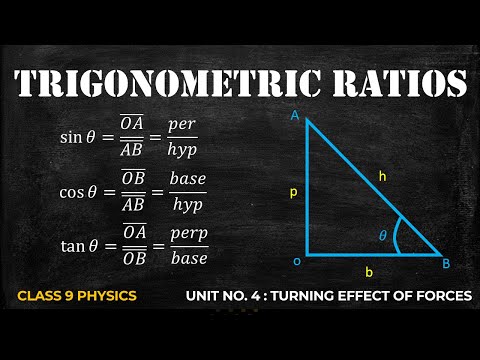
Figure: Right-angled triangle showing sides relative to angle $\theta$.
There are six trigonometric ratios in total, out of which three are primary ratios and the other three are their reciprocals. The three main ratios mostly used in physics are sine, cosine, and tangent.
Consider a right-angled triangle having angle $\theta$: relative to this angle, the sides are defined as:
- Perpendicular (Opposite): The side opposite to angle $\theta$.
- Base (Adjacent): The side next to angle $\theta$.
- Hypotenuse: The longest side opposite to the right angle ($90^\circ$).
Three Main Trigonometric Ratios
$\sin\theta = \frac{\text{Perpendicular}}{\text{Hypotenuse}} = \frac{\text{Opposite}}{\text{Hypotenuse}}$
$\cos\theta = \frac{\text{Base}}{\text{Hypotenuse}} = \frac{\text{Adjacent}}{\text{Hypotenuse}}$
$\tan\theta = \frac{\text{Perpendicular}}{\text{Base}} = \frac{\text{Opposite}}{\text{Adjacent}}$
Reciprocal Ratios
The three reciprocal ratios corresponding to cosecant, secant, and cotangent are:
- Cosecant ($\csc\theta$): Reciprocal of sine ($\frac{\text{Hypotenuse}}{\text{Perpendicular}}$)
- Secant ($\sec\theta$): Reciprocal of cosine ($\frac{\text{Hypotenuse}}{\text{Base}}$)
- Cotangent ($\cot\theta$): Reciprocal of tangent ($\frac{\text{Base}}{\text{Perpendicular}}$)
No comments:
Post a Comment